Geography study method

How to memorize world capitals: a ten-minute study plan.

Choose five country–capital pairs. Read them once, cover the capitals and write what you remember. Check your answers, locate the countries on a map and return to the missed pairs tomorrow. Use the ten-minute plan below as a starting routine, then adjust the pace to what you can recall.

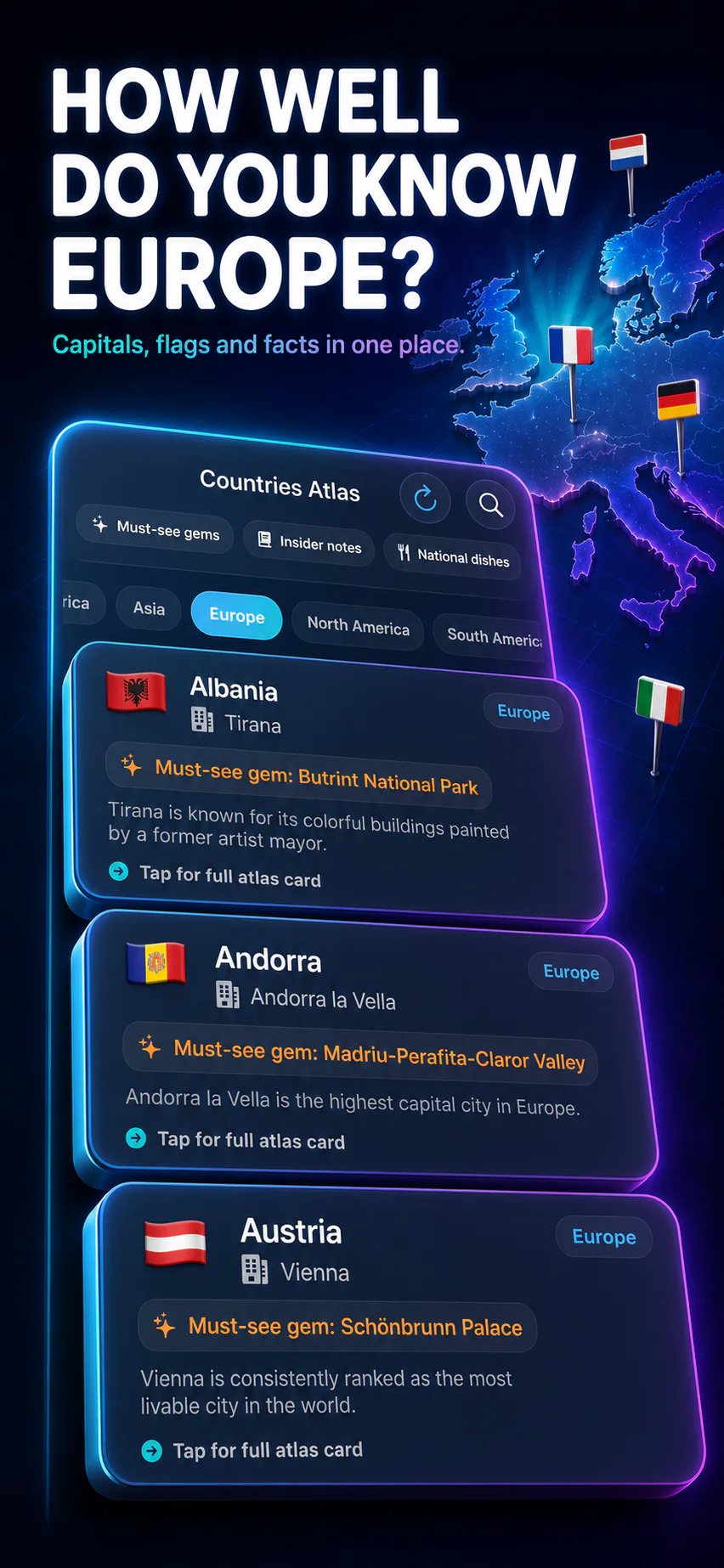
GeoCapitals atlas card with country and capital context

Paper, a map and five pairs

A ten-minute routine you can try today

This is a suggested session length, not a promise to learn every capital in ten minutes. Choose a small set from the European capitals study sheet or your course list.

  1. Minutes 0–2: read and locate. Write five country–capital pairs. Find each country on a map and say both names aloud.
  2. Minutes 2–5: cover and recall. Cover the capital column. Write an answer for each country before looking, then check and correct it.
  3. Minutes 5–7: reverse the prompt. Cover the country column instead. Identify the country from its capital in a different order.
  4. Minutes 7–9: work on mistakes. Pick the pairs you confused. Write one difference or location clue for each, then test them again.
  5. Minute 9–10: plan the next check. Mark uncertain pairs and schedule another attempt tomorrow. Add more countries after you can recall the current set in a later session.

Worked example: the three Baltic capitals

Read the countries from north to south: Estonia—Tallinn, Latvia—Riga, Lithuania—Vilnius. Find them on a map, then cover this line. Answer the questions below before opening the key.

  1. What is the capital of Latvia?
  2. Which country has Tallinn as its capital?
  3. What is the capital of Lithuania?
Check the three answers

1. Riga. 2. Estonia. 3. Vilnius. If Riga and Vilnius swapped places in your answer, write Latvia—Riga and Lithuania—Vilnius together and test both again after a break.

Next, mix these pairs into the European capitals practice guide and use its study sheet to choose your next countries.

When to review countries and capitals

Try an initial session, a check the next day, another three days later and a mixed round a week later. These intervals are a starting suggestion. Bring a missed pair back sooner; leave a longer gap for a pair you can still recall. Record answers given before checking, not just answers that look familiar.

The general approach follows AERO’s guidance on spacing and retrieval practice. The geography examples and suggested timings here are our own application of those principles.

Four habits for learning countries and capitals

Give every practice session a single clear objective. Build reliable recall instead of passive recognition.

1. Small regional groups

Start with a few neighbouring countries, such as the Baltic states. Add names gradually and use your syllabus or a dated country list to decide the scope. Some countries have more than one capital role, so keep the role with the answer.

2. Recall in both directions

Always practice prompts in both directions: given “Australia,” recall “Canberra”; given “Reykjavik,” identify “Iceland.” Practicing both directions helps you check recall without relying on a fixed answer order.

3. Add a location clue

Find the country on a map and name a neighbour or coastline. Add its flag if you are also learning flags. Check each skill separately: recognising a flag does not yet show that you can recall the capital.

4. Return to missed pairs

Use your mistakes to decide what to review next. Isolate errors into an immediate review queue, revisit them 24 hours later, and verify mastery in a mixed global challenge.
How to separate capitals you keep confusing

Overcome tricky, non-intuitive, or easily confused capital names with targeted associative memory strategies.

Phonetic association links

Create a vivid mental story linking the country sound to the capital sound. For example, connect Madagascar with Antananarivo by visualizing a giant lemur stepping into an ancient forest canopy with an antenna.

The largest city trap

Dozens of nations do not have their largest or most famous metropolis as the capital. Actively flag false assumptions early: Ottawa (not Toronto or Montreal), Brasília (not Rio or São Paulo), Ankara (not Istanbul), and Bern (not Zurich).

Separate similar country names

Write the complete pairs rather than studying names alone. For example, Slovakia—Bratislava and Slovenia—Ljubljana need distinct country clues. Try the Slovakia vs Slovenia exercise to practise the distinction.

Add speed after accuracy

Once you can answer accurately without a timer, try a short timed round if speed matters for your quiz or exam. If you start guessing, return to untimed recall and check the pairs you missed.

Frequently asked questions about memorizing world capitals

Answers to common questions about retention timelines, study techniques, and geography learning tools.

How should I start memorizing world capitals?

Start with five country–capital pairs from your study list. Cover the answers, recall each pair in both directions, check mistakes and revisit the set after a break. Add countries gradually and note cases with more than one capital role.

Should I read a capitals list or test myself?

Use a list to check facts, then cover it and try to answer from memory. Testing yourself shows which pairs you can retrieve without the answer in view. Check mistakes promptly and try again later.

How long does it take to learn every capital city in the world?

The time needed varies with your starting knowledge and practice routine. Use short regional sessions and track which country-capital pairs you can recall after a break before expanding your study set.

How do mnemonics help with tricky capital cities?

Phonetic word associations bridge unfamiliar names into memorable mental images—for example, remembering that Ouagadougou is the capital of Burkina Faso by imagining a fast runner heading to a futuristic city, or pairing Ulaanbaatar with Mongolia through historical steppe imagery.

Explore a capitals exam revision plan or alternatives to geography flashcards for a practical next step.

Keep your study loop going.

GeoCapitals helps you practice capitals, countries, flags, and maps on iPhone and iPad with adaptive review.

Download on App Store

Keep swapping two countries?

Compare the countries you confuse, or try the Slovakia vs Slovenia exercise with flags, a map, capitals and neighbours.